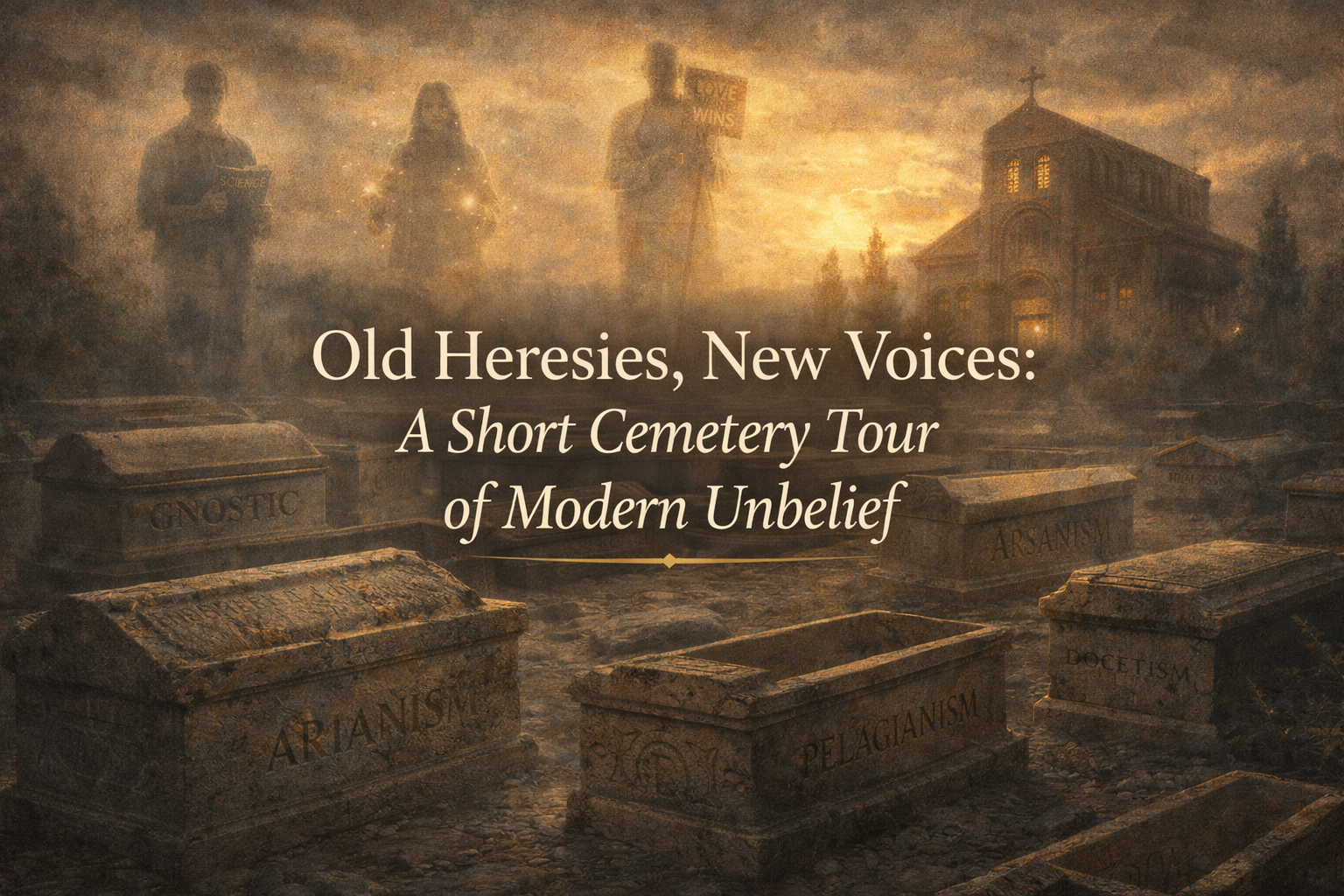
Old Heresies, New Voices: A Short Cemetery Tour of Modern Unbelief
There is nothing new under the sun.
– Ecclesiastes (1:9)
For there must be heresies among you in order that those who are genuine among you may be recognized.
– 1 Corinthians 11:19
The Illusion of Novelty
Modern objections to Christianity almost always present themselves as breakthroughs. They come clothed in the language of progress, maturity, science, compassion, or personal authenticity. They speak as if the world has finally outgrown superstition, or as if Christianity has at last been exposed as a culturally conditioned relic—something suitable for the ancient world but untenable for the modern mind.
Yet this impression of novelty is almost entirely an illusion.
What passes today as bold critique or enlightened skepticism is, in the vast majority of cases, nothing more than the repetition of positions already articulated, examined, refuted, and doctrinally buried many centuries ago. The vocabulary has changed; the errors have not. The confidence is louder; the substance is thinner.
Christianity did not grow in an intellectual vacuum. From its earliest decades it was challenged by philosophers, mystics, moralists, skeptics, relativists, spiritual enthusiasts, and political theorists. These challenges were not ignored. They were named, analyzed, answered, and—where necessary—condemned. The Church did not merely survive these encounters; she clarified her doctrines through them, distinguishing truth from distortion with increasing precision.
For this reason, Christianity does not improvise answers to modern objections. It remembers.
This text therefore does not attempt to debate common modern assertions. Debate presupposes that a question remains genuinely open. In many cases, it does not. Instead, what follows is a simple act of identification. Each claim is paired with its historical counterpart, its doctrinal diagnosis, the authoritative refutation that answered it, and the approximate date at which the matter was considered settled.
The purpose is not polemics but memory.
Heresies have always existed—not because truth is fragile, but because clarity requires contrast. Error does not innovate; it recycles. What changes is not the content of the denial but the generation that forgets it has already been answered.
What follows, then, is not a collection of arguments, but a catalogue of repetitions. A brief walk through a graveyard of ideas that are frequently mistaken for discoveries.
1. “Matter is all that exists; there is no soul or spiritual reality.”
Corresponding Ancient Error / Heresy:
Materialism (Epicurean–Democritean line, revived periodically)
Core Error Identified:
Denial of immaterial substance and spiritual intellect.
Authoritative Refutation:
Gregory of Nyssa, On the Soul and the Resurrection
Date Settled & Buried:
4th century (c. AD 380)
Current Status:
Philosophically incoherent; metaphysically refuted; only survives as scientistic prejudice.
2. “The Bible is just an old mythological text like other ancient stories.”
Corresponding Ancient Error / Heresy:
Pagan myth reductionism
Core Error Identified:
Denial of divine revelation and prophetic fulfillment.
Authoritative Refutation:
Justin Martyr, Dialogue with Trypho
Date Settled & Buried:
Mid–2nd century (c. AD 155–160)
Current Status:
Historically illiterate; refuted before Christianity became legally tolerated.
3. “Being a good person is what matters, regardless of religion.”
Corresponding Ancient Error / Heresy:
Pelagian moralism (ethical naturalism)
Core Error Identified:
Substitution of moral effort for sanctifying grace.
Authoritative Refutation:
Augustine of Hippo, On the Spirit and the Letter
Date Settled & Buried:
Condemned at the Councils of Carthage (AD 418)
Current Status:
Officially rejected; persists as sentimental moralism.
4. “Jesus was divine, but He was not truly human.”
Corresponding Ancient Error / Heresy:
Docetism
Core Error Identified:
Denial of the true humanity of Christ; reduction of the Incarnation to appearance.
Authoritative Refutation:
Ignatius of Antioch, Letter to the Smyrnaeans
Date Settled & Buried:
Early 2nd century (c. AD 110)
Current Status:
Apostolically condemned; incompatible with redemption through real flesh and blood.
5. “The soul is good, the body is a burden; salvation is escape from matter.”
Corresponding Ancient Error / Heresy:
Gnosticism
Core Error Identified:
Denigration of the body and denial of the goodness of creation.
Authoritative Refutation:
Tertullian, On the Resurrection of the Flesh
Date Settled & Buried:
Late 2nd–early 3rd century (c. AD 210)
Current Status:
Doctrinally extinct; survives only in New Age and disembodied spiritualities.
6. “Human nature is basically good; sin is mostly social conditioning.”
Corresponding Ancient Error / Heresy:
Pelagianism
Core Error Identified:
Denial of original sin and the necessity of prevenient grace.
Authoritative Refutation:
Council of Carthage
Date Settled & Buried:
AD 418
Current Status:
Formally condemned; reappears today as therapeutic optimism.
7. “I don’t need the Church; personal spiritual experience is enough.”
Corresponding Ancient Error / Heresy:
Montanism (spiritual individualism)
Core Error Identified:
Private inspiration elevated above apostolic authority and sacramentality.
Authoritative Refutation:
Eusebius of Caesarea, Ecclesiastical History, Book V
Date Settled & Buried:
Late 2nd century (c. AD 180–200)
Current Status:
Rejected as schismatic enthusiasm; persists in radical individualism.
8. “Dogma changes; truth evolves with culture.”
Corresponding Ancient Error / Heresy:
Doctrinal relativism (proto-modernism)
Core Error Identified:
Confusion of growth in understanding with mutation of truth.
Authoritative Refutation:
Vincent of Lérins, Commonitorium
Date Settled & Buried:
Mid–5th century (c. AD 434)
Current Status:
Explicitly excluded by the same meaning, same judgment rule.
9. “Hell is only symbolic; God would never punish eternally.”
Corresponding Ancient Error / Heresy:
Origenism (later speculative distortions of apokatastasis)
Core Error Identified:
Denial of eternal consequence and final judgment.
Authoritative Refutation:
Second Council of Constantinople
Date Settled & Buried:
AD 553
Current Status:
Explicitly condemned; persists today as sentimental universalism.
10. “All religions lead to the same truth and save the soul.”
Corresponding Ancient Error / Heresy:
Syncretism
Core Error Identified:
Denial of the uniqueness of Christ and the Incarnation as the sole means of salvation.
Authoritative Refutation:
Irenaeus of Lyons, Against Heresies, Book III
Date Settled & Buried:
Late 2nd century (c. AD 180–190)
Current Status:
Doctrinally impossible within Christianity; survives only through religious flattening.
11. “The Resurrection is spiritual, not bodily.”
Corresponding Ancient Error / Heresy:
Proto-Docetism / Hymenaean error
Core Error Identified:
Denial of the resurrection of the flesh.
Authoritative Refutation:
Cyril of Jerusalem, Catechetical Lectures
Date Settled & Buried:
Mid-4th century (c. AD 348–350)
Current Status:
Universally condemned; contradicts the Apostles’ Creed.
12. “Morality is self-defined; sin is an outdated concept.”
Corresponding Ancient Error / Heresy:
Antinomianism
Core Error Identified:
Severing grace from moral law and repentance.
Authoritative Refutation:
John Chrysostom, Homilies on Romans
Date Settled & Buried:
Late 4th century (c. AD 386–390)
Current Status:
Doctrinally incoherent; reappears as moral autonomy.
13. “The Bible is merely a cultural product shaped by its time.”
Corresponding Ancient Error / Heresy:
Reductionism (early rationalist critique of revelation)
Core Error Identified:
Denial of divine inspiration and prophetic authority.
Authoritative Refutation:
Justin Martyr, First Apology
Date Settled & Buried:
Mid-2nd century (c. AD 150–160)
Current Status:
Historically obsolete; repeats pre-Christian pagan objections.
14. “Faith is blind; reason and science have replaced it.”
Corresponding Ancient Error / Heresy:
Rationalism / Scientism (false opposition between faith and reason)
Core Error Identified:
Reduction of reason to empirical method; denial that faith is ordered to truth and intelligibility.
Authoritative Refutation:
Athenagoras of Athens, A Plea for the Christians
Date Settled & Buried:
Mid–2nd century (c. AD 150)
Current Status:
Philosophically naïve; Christianity affirmed logos centuries before modern science existed.
15. “Religion is mainly a tool for social control or political power.”
Corresponding Ancient Error / Heresy:
Political reductionism (proto-materialism)
Core Error Identified:
Collapse of transcendence into sociology; denial of divine origin of revelation.
Authoritative Refutation:
Origen of Alexandria, Contra Celsum
Date Settled & Buried:
Early 3rd century (c. AD 248)
Current Status:
Historically illiterate; refuted by Christianity’s origin in persecution, not power.
16. “Dogma and belief must adapt to modern moral sensibilities.”
Corresponding Ancient Error / Heresy:
Modernism (doctrinal subjectivism)
Core Error Identified:
Subordination of revealed truth to historical mood or moral fashion.
Authoritative Refutation:
Vincent of Lérins, Commonitorium
Date Settled & Buried:
Principle articulated mid–5th century (c. AD 434)
Current Status:
Explicitly excluded; truth develops in clarity, not in contradiction.
17. “God is pure love; judgment, wrath, or punishment are incompatible with Him.”
Corresponding Ancient Error / Heresy:
Selective theism (sentimentalism)
Core Error Identified:
Division of divine attributes; denial of divine justice.
Authoritative Refutation:
Athanasius of Alexandria, On the Incarnation
Date Settled & Buried:
Mid-4th century (c. AD 340)
Current Status:
Doctrinal distortion; mercy severed from justice becomes fiction.
18. “Christian doctrines are later inventions, not part of original Christianity.”
Corresponding Ancient Error / Heresy:
Historical skepticism (early anti-Christian polemic)
Core Error Identified:
Denial of apostolic continuity and doctrinal transmission.
Authoritative Refutation:
Irenaeus of Lyons, Against Heresies, Book III
Date Settled & Buried:
Late 2nd century (c. AD 180)
Current Status:
Refuted by living succession of bishops, creeds, and liturgy.
The Burden of Forgetting
The most striking feature of modern unbelief is not its audacity, but its amnesia.
Many of the objections that circulate today—whether spoken with hostility, indifference, or moral confidence—were already familiar to Christians long before Christianity held social power, long before it shaped institutions, and long before it was politically convenient to profess belief at all. These questions were asked when doing so carried personal risk rather than cultural approval.
They were answered then. They remain answered now.
To say that a belief was condemned centuries ago is not to silence inquiry, nor to forbid thought. It is simply to acknowledge that thought has a history. One may reject the Church’s conclusions, but one cannot honestly pretend that those conclusions were never reached, or that the ground has not already been covered.
What this catalogue exposes, therefore, is not the weakness of Christianity, but the shallowness of many contemporary critiques. Their persistence is not evidence of unresolved tension, but of widespread ignorance—sometimes culpable, sometimes inherited, often unexamined.
Christianity is not endangered by the repetition of ancient errors. It has survived them all before. The greater danger lies elsewhere: in Christians themselves forgetting their own intellectual and doctrinal inheritance, and thus mistaking refuted claims for serious challenges.
There is, indeed, nothing new under the sun.
Only old errors, wearing modern clothes, waiting to be recognized for what they have always been.
 Blog do Fernando Rees