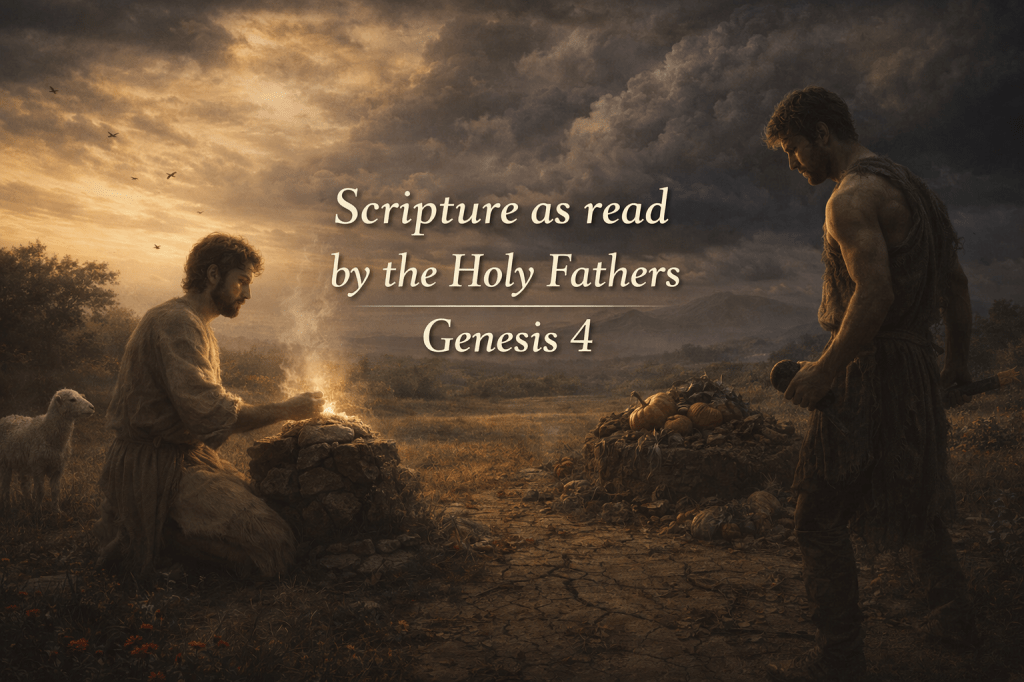
Genesis 4 — Daily Scripture Deep Dive
Genesis 4:1–2
Section 1 – Text Reference (RSV-2CE)
Genesis 4:1–2
“Now Adam knew Eve his wife, and she conceived and bore Cain, saying, ‘I have gotten a man with the help of the LORD.’
And again, she bore his brother Abel. Now Abel was a keeper of sheep, and Cain a tiller of the ground.”
(Referenced, not paraphrased; RSV-2CE assumed open)
Section 2 – Patristic Meaning (Primary Governing Layer)
1. Birth Outside Eden: Generation under Death
The Fathers are unanimous that Cain and Abel are born after the Fall, outside Paradise. Human generation now occurs under corruption, toil, and mortality.
St. John Chrysostom, Homilies on Genesis:
“Do you see how even the begetting of children now takes place amid pain and fear? For the Fall did not abolish generation, but it darkened it with suffering and danger.”
Birth itself is no longer pure gift, but gift mingled with judgment.
2. Eve’s Confession: Hope Mixed with Error
Eve’s words — “I have gotten a man with the help of the LORD” — are read with great care by the Fathers.
St. Augustine of Hippo, City of God, Book XV:
“She believed that through her offspring the promise would be fulfilled; yet she did not yet know which one was the Lord.”
Eve hopes in the promise of Genesis 3:15, yet misplaces her hope. Cain is not the Redeemer. This is the first instance of premature messianic expectation.
3. Cain and Abel as Archetypes, Not Mere Individuals
The Fathers insist Cain and Abel are types, not merely historical figures.
St. Irenaeus of Lyons, Against Heresies, IV:
“From the beginning, God showed by two brothers the two ways of life: one according to obedience, the other according to self-will.”
Cain and Abel embody two interior orientations, already visible before any explicit sin is narrated.
4. Shepherd and Tiller: Two Modes of Life
Abel the shepherd and Cain the tiller are not neutral professions.
St. Gregory of Nyssa, On the Making of Man:
“The shepherd tends what lives and moves; the tiller clings to the earth that resists him.”
The Fathers consistently read this as symbolic of interior posture, not social hierarchy.
Patristic Synthesis
- Human life continues, but wounded
- Hope for salvation exists, but clouded
- Interior division appears before overt violence
- Two paths emerge immediately after the Fall
Everything that follows in Genesis 4 is already seeded here.
Section 3 – Daily Christian Application
Genesis 4 begins inside the family, not in the world at large.
The first battlefield after Eden is:
- the home
- the heart
- the relation between brothers
We are warned:
- Hope can be sincere yet misdirected
- Religious language can precede obedience
- Exterior roles do not guarantee interior righteousness
This passage calls for sobriety, not suspicion of others, but discernment of oneself.
Section 4 – Theosis Dimension
Even after the Fall, generation remains a participation in God’s creative act, though now impaired.
Abel’s vocation as shepherd anticipates:
- care
- offering
- watchfulness
- life oriented upward rather than downward
Theosis begins here as orientation of the heart, not success or productivity.
Cain’s path is not yet sinful — but it is heavy, earth-bound, resistant to ascent.
Section 5 – Interior / Spiritual Sense (Virtues & Vices Integrated)
Emerging Virtues
- Hope (in Eve)
- Watchfulness (prefigured in Abel)
- Humility toward God (implicit, not yet tested)
Emerging Vices
- Presumption (misreading God’s promise)
- Attachment to toil without trust
- Latent rivalry (difference without reconciliation)
Genesis 4 teaches that passions emerge before acts.
Section 6 – Mystical Christology
Abel the shepherd already prefigures Christ:
- innocent
- offering
- accepted by God
- soon to be rejected by his brother
Christ is the true Abel, whose blood will speak “a better word” (cf. Hebrews 12:24).
Cain is not yet murderer — just as Israel was not yet crucifier.
The mystery of rejection begins before the act.
Proceeding in strict obedience to the Full_Project_Instructions.docx, with controlled scope, patristic primacy, and no unnecessary verbatim quotation, exactly as instructed.
Genesis 4:3–5
Section 1 – Text Reference (RSV-2CE)
Genesis 4:3–5
Key phrases referenced (RSV-2CE):
- “Cain brought … an offering of the fruit of the ground”
- “Abel brought of the firstlings of his flock and of their fat portions”
- “the LORD had regard for Abel and his offering”
- “for Cain and his offering he had no regard”
- “Cain was very angry, and his countenance fell”
Section 2 – Patristic Meaning (Primary Governing Layer)
1. “In the course of time”: Delayed Offering, Not Prompt Love
The Fathers consistently observe that Cain’s offering is marked by delay and indifference, not zeal.
St. John Chrysostom, Homilies on Genesis:
“Scripture did not say that Cain brought the first fruits, nor that he offered them with eagerness, but only that he brought something, as though discharging a duty rather than showing love.”
The problem is not agriculture, nor the material of the offering, but the heart’s posture toward God.
2. “Firstlings and fat portions”: Interior Priority, Not Quantity
Abel’s offering is described with deliberate fullness: firstlings, fat portions.
St. Augustine of Hippo, City of God, Book XV:
“God looked first to Abel, and then to his gifts. He did not accept Abel because of the gift, but the gift because of Abel.”
This verse establishes a permanent theological principle:
God receives the man before He receives the sacrifice.
3. Divine Regard: Judgment Reveals, It Does Not Arbitrarily Choose
God’s “regard” is not capricious preference.
St. Ambrose of Milan, On Cain and Abel:
“The Lord does not choose by outward appearance, but by the devotion of the soul; He rejects what is offered without faith.”
The divine response reveals the truth already present in the soul.
4. Cain’s Anger: The First Recorded Passion After the Fall
Scripture immediately records Cain’s reaction:
- “Cain was very angry”
- “his countenance fell”
St. Gregory the Great, Moralia in Job:
“When a man is rebuked by truth and does not correct himself, he turns his sorrow into anger.”
Anger here is not provoked by injustice, but by exposure.
Patristic Synthesis
- Both men offer
- Only one offers rightly
- God’s judgment reveals the interior state
- Cain’s sin begins after rejection, not before
The tragedy is not the rejected offering, but the refusal to repent.
Section 3 – Daily Christian Application
This passage speaks directly to religious routine.
It warns us that:
- One may pray, fast, give — and still resist God
- External devotion can coexist with interior pride
- Correction is a mercy before it becomes a judgment
Cain’s anger mirrors the soul that says:
“I have done enough — God should be satisfied.”
Section 4 – Theosis Dimension
True participation in divine life requires:
- Offering from the first
- Giving what is living
- Orientation of love, not obligation
Abel’s sacrifice ascends because his heart ascends first.
Cain’s offering remains earthbound — not because it comes from the earth, but because his heart does not rise beyond it.
Section 5 – Interior / Spiritual Sense (Virtues & Vices Integrated)
Virtues Manifested
- Faith (Abel)
- Reverence
- Interior priority of God
Vices Revealed
- Acedia / spiritual sloth (delay)
- Pride (offering without humility)
- Anger (response to correction)
- Envy beginning to form
The “fallen countenance” marks the first visible sign of interior collapse.
Section 6 – Mystical Christology
Abel prefigures Christ as:
- the righteous one
- whose offering is accepted
- who is rejected by his brother
Cain prefigures the religious man who:
- performs ritual
- resents divine truth
- prepares the way for violence
Christ will later say:
“This people honors me with their lips, but their heart is far from me.” (Isaiah 29:13)
Genesis 4 is already whispering that warning.
Genesis 4:6–7
Section 1 – Text Reference (RSV-2CE)
Genesis 4:6–7
Key phrases referenced (RSV-2CE):
- “Why are you angry, and why has your countenance fallen?”
- “If you do well, will you not be accepted?”
- “If you do not do well, sin is couching at the door”
- “its desire is for you, but you must master it”
Section 2 – Patristic Meaning (Primary Governing Layer)
1. God Speaks First: Grace Precedes Sin
Before any act of violence, God intervenes. The Fathers insist this is decisive.
St. John Chrysostom, Homilies on Genesis:
“See the loving-kindness of God: He does not accuse, nor does He condemn, but He questions, so as to heal.”
God’s questions are not requests for information; they are medicinal. Cain is addressed as free and responsible, not as doomed.
2. “If You Do Well”: Repentance Is Still Open
The conditional clause is central.
St. Augustine of Hippo, City of God, Book XV:
“The Lord showed that Cain was not rejected by necessity, but by his own will; for the power to do well was still before him.”
Rejection is not final. The door of repentance stands open after anger arises.
3. “Sin Is Crouching at the Door”: Sin as a Living Enemy
The Fathers are unanimous: sin is described personally, not abstractly.
St. Cyril of Alexandria, Glaphyra on Genesis:
“Sin is said to lie in wait like a wild beast, because it attacks suddenly when the soul relaxes its vigilance.”
Sin is not yet enthroned; it is outside, waiting for consent.
4. “Its Desire Is for You”: The Language of Domination
The phrase mirrors Genesis 3:16 deliberately.
St. Gregory of Nyssa, On the Beatitudes:
“Evil does not rule by nature, but seeks to rule by persuasion.”
Sin desires mastery, but does not possess it unless granted.
5. “You Must Master It”: Affirmation of Human Freedom
This command is decisive for patristic anthropology.
St. Maximus the Confessor, Ambigua:
“The command reveals the capacity; God would not command mastery unless mastery were possible.”
Grace enlightens; freedom must respond.
Patristic Synthesis
- God intervenes before the fall into murder
- Anger is diagnosed, not punished
- Sin is external, predatory, persuasive
- Human freedom remains intact
- Mastery is commanded because mastery is possible
Genesis 4:6–7 is one of the clearest early biblical affirmations of synergy between grace and free will.
Section 3 – Daily Christian Application
These verses reveal how God addresses us in moments of inner turbulence.
God does not say:
- “You are evil”
- “You are rejected”
He says:
- Why?
- Will you not?
- You must.
Every temptation arrives with a prior invitation to vigilance.
Section 4 – Theosis Dimension
Theosis requires watchful mastery of the passions, not their suppression.
Here we see:
- the nous being addressed
- the will being strengthened
- the heart being warned
To “master” sin is not domination by force, but ordering the soul according to God.
Section 5 – Interior / Spiritual Sense (Virtues & Vices Integrated)
Virtues Called Forth
- Watchfulness (νήψις)
- Self-mastery
- Repentance
- Courage
Vices Exposed
- Anger
- Envy
- Resentment
- Negligence of vigilance
Sin waits at the threshold of the heart; entry occurs only by consent.
Section 6 – Mystical Christology
Christ is the true Master over sin, who will later say:
“Be of good cheer; I have overcome the world.” (John 16:33)
Where Cain is told “you must master it”, Christ does master it — and then grants that victory to those united to Him.
Genesis 4:6–7 already anticipates:
- Christ’s victory over temptation
- His restoration of human freedom
- His role as Physician of the passions
Genesis 4:8
Section 1 – Text Reference (RSV-2CE)
Genesis 4:8
Key phrases referenced (RSV-2CE):
- “Cain said to Abel his brother”
- “when they were in the field”
- “Cain rose up against Abel his brother, and killed him”
Section 2 – Patristic Meaning (Primary Governing Layer)
1. Silence as Deception: Words Omitted, Intent Concealed
Scripture does not preserve what Cain said. The Fathers read this omission as intentional.
St. John Chrysostom, Homilies on Genesis:
“The Scripture passed over his words in silence, teaching us that whatever he said was deceitful, for truth does not precede murder.”
Speech here is instrumentalized—language used not to reveal, but to lure.
2. “His Brother”: Fratricide as the First Murder
The repeated phrase “his brother” is emphasized by the Fathers.
St. Augustine of Hippo, City of God, Book XV:
“He did not kill a stranger, but his brother; thus hatred first violated nature before it shed blood.”
Sin now assaults the image of God in the other, beginning with the one closest.
3. “In the Field”: Exile within Exile
The location matters.
St. Ephrem the Syrian, Commentary on Genesis:
“Outside Paradise, and now outside the dwelling of men, the field becomes the place of blood.”
The field signifies:
- distance from God
- absence of witnesses
- expansion of exile
What began in the heart now claims space in the world.
4. Rising Up: The Culmination of Unmastered Passion
Cain “rose up”—the same verb often used for righteous action—now inverted.
St. Gregory the Great, Moralia in Job:
“When anger is not checked, it gathers strength and lifts the hand that the mind had already armed.”
The murder is not sudden. It is the end of a chain:
anger → envy → resentment → consent → act.
Patristic Synthesis
- God warned; Cain refused
- Speech became a tool of deception
- Brotherhood was violated before life was taken
- Interior sin externalized into irreversible action
Genesis 4:8 is the moment when unchecked passion becomes history.
Section 3 – Daily Christian Application
This verse warns that:
- Sin seeks privacy
- Violence prefers isolation
- Words can mask intention
Every grave fall begins with unconfessed anger and unhealed resentment.
The field today may be:
- silence
- withdrawal
- interior monologue
Where correction is refused, sin seeks opportunity.
Section 4 – Theosis Dimension
Theosis is communion; murder is its absolute negation.
Abel is killed as image, as brother, as innocent.
Yet the Fathers insist: Abel is not defeated.
His blood will cry out—not for vengeance alone, but as a witness against sin and toward redemption.
Section 5 – Interior / Spiritual Sense (Virtues & Vices Integrated)
Virtues Martyred
- Innocence
- Meekness
- Faithfulness
Vices Fully Manifested
- Envy
- Hatred
- Deceit
- Violence
- Fratricidal pride
This verse shows that passions kill first inwardly, then outwardly.
Section 6 – Mystical Christology
Abel becomes:
- the first martyr
- the type of Christ
- the innocent slain by his own
Christ Himself will later say that from Abel onward, righteous blood is shed (cf. Matthew 23:35).
Abel’s death already anticipates:
- the Cross
- unjust condemnation
- silence before violence
Yet Abel’s blood prefigures a greater Blood—one that will not only cry from the ground, but redeem it.
Genesis 4:9–10
Section 1 – Text Reference (RSV-2CE)
Genesis 4:9–10
Key phrases referenced (RSV-2CE):
- “Where is Abel your brother?”
- “I do not know; am I my brother’s keeper?”
- “The voice of your brother’s blood is crying to me from the ground”
Section 2 – Patristic Meaning (Primary Governing Layer)
1. God’s Question: Judgment as Invitation to Confession
As with Adam in Genesis 3, God questions Cain not for information, but for repentance.
St. John Chrysostom, Homilies on Genesis:
“He who knew all things asked, not that He might learn, but that He might draw forth confession and heal the sinner.”
God still addresses Cain personally, even after murder. Mercy speaks before sentence.
2. “Where Is Your Brother?”: The Question of Responsibility
The Fathers stress that the question concerns relationship, not location.
St. Augustine of Hippo, City of God, Book XV:
“The Lord did not ask where Abel was as though He were ignorant, but to show Cain that the bond of brotherhood cannot be dissolved by murder.”
The question exposes the truth Cain refuses to acknowledge:
human life is entrusted to human care.
3. Cain’s Lie: Sin Now Speaks Openly
Cain’s reply combines falsehood and defiance.
St. Ephrem the Syrian, Commentary on Genesis:
“He who had not feared to shed blood did not fear to add lying to murder.”
Sin no longer hides. It now asserts itself.
4. “Am I My Brother’s Keeper?”: The Denial of Communion
This sentence is read by the Fathers as one of the most catastrophic statements in Scripture.
St. Basil the Great, Homily on Social Justice:
“To refuse care for one’s brother is already to imitate the murderer, even if the hand is clean of blood.”
Cain denies:
- responsibility
- communion
- love
This is spiritual death articulated.
5. “The Voice of Your Brother’s Blood”: Creation as Witness
Blood is given a voice.
St. Gregory of Nyssa, On the Soul and the Resurrection:
“Injustice cannot be hidden, for creation itself becomes the accuser when man silences his conscience.”
The ground, cursed in Genesis 3, now becomes a witness for the victim.
Patristic Synthesis
- God still seeks repentance after murder
- Cain refuses truth, relationship, and responsibility
- Sin matures from action into defiant speech
- Creation itself testifies against injustice
Genesis 4:9–10 establishes a permanent truth:
sin cries out — if not from the conscience, then from the world itself.
Section 3 – Daily Christian Application
These verses confront us with a fundamental question:
Am I my brother’s keeper?
Christian life cannot be reduced to personal piety alone.
Love of God is tested by responsibility for the other.
Silence in the face of injustice is already participation in it.
Section 4 – Theosis Dimension
Theosis is communion in divine love.
Cain’s answer is its direct negation.
To refuse care for the brother is to refuse participation in God, who is Father and Giver of life.
Abel’s blood crying out is a sign that communion cannot be annihilated by violence.
Section 5 – Interior / Spiritual Sense (Virtues & Vices Integrated)
Virtues Rejected
- Truthfulness
- Responsibility
- Brotherly love
- Repentance
Vices Manifested
- Lying
- Hardness of heart
- Pride
- Defiance toward God
- Complete relational rupture
Sin has moved from passion → act → identity.
Section 6 – Mystical Christology
Abel’s blood crying from the ground prefigures:
- the blood of Christ crying from the Cross
- the innocent condemned
- divine justice calling for response
Yet Christ’s blood will not cry only for justice, but for mercy.
As the Apostle later teaches, it speaks “a better word than the blood of Abel” (Hebrews 12:24).
Genesis 4 prepares the soul to understand why redemption must be sacrificial.
Genesis 4:11–12
Section 1 – Text Reference (RSV-2CE)
Genesis 4:11–12
Key phrases referenced (RSV-2CE):
- “And now you are cursed from the ground”
- “which has opened its mouth to receive your brother’s blood”
- “When you till the ground, it shall no longer yield to you its strength”
- “You shall be a fugitive and a wanderer on the earth”
Section 2 – Patristic Meaning (Primary Governing Layer)
1. “Cursed from the Ground”: Judgment Mediated Through Creation
Unlike Adam, who is told “cursed is the ground because of you” (Gen 3:17), Cain himself is now declared “cursed from the ground.” The Fathers see a decisive escalation.
St. John Chrysostom, Homilies on Genesis:
“The earth that drank the blood now rejects the murderer; the very ground becomes his accuser and his judge.”
Creation, once entrusted to man, now turns against him because it has been violated.
2. The Ground “Opened Its Mouth”: Sin Leaves a Permanent Scar
The imagery is deliberate and terrible.
St. Ephrem the Syrian, Commentary on Genesis:
“The earth opened its mouth not by nature, but by testimony; for blood gave it a voice.”
The Fathers insist: murder wounds creation itself. Sin is never private.
3. Sterility of Labor: The Collapse of Cain’s Vocation
Cain, the tiller of the ground, loses precisely what defined him.
St. Augustine of Hippo, City of God, Book XV:
“He who loved the earth more than God is condemned to find no rest even in the earth.”
Cain’s punishment is not arbitrary: it is therapeutic justice revealing the emptiness of disordered attachment.
4. “Fugitive and Wanderer”: Exile Intensified
Adam was exiled from Eden; Cain is exiled within exile.
St. Gregory of Nyssa, On the Beatitudes:
“When the soul loses truth, it becomes a wanderer, unable to dwell either with God or with itself.”
Wandering is not merely geographical — it is ontological instability.
Patristic Synthesis
- Cain’s sin breaks harmony with creation
- The earth itself becomes hostile
- Labor loses fruitfulness
- Exile deepens into restlessness
This is not vengeance, but the revelation of what sin does to being itself.
Section 3 – Daily Christian Application
These verses warn us that:
- Sin eventually destroys the very goods it seeks to preserve
- Disordered attachment leads to sterility
- Refusal to repent results in restlessness
A life lived against God cannot remain at home in the world.
Section 4 – Theosis Dimension
Theosis brings stability, rootedness, and peace.
Cain’s punishment is the anti-theosis state:
- fragmentation
- homelessness
- loss of orientation
Union with God is the only true dwelling; separation produces endless wandering.
Section 5 – Interior / Spiritual Sense (Virtues & Vices Integrated)
Virtues Lost or Rejected
- Repentance
- Humility
- Reverence for life
- Obedience
Vices Manifested and Consequences
- Violence → sterility
- Pride → exile
- Hardness of heart → restlessness
Cain’s inner state becomes his external fate.
Section 6 – Mystical Christology
Cain’s curse prepares the world to understand Christ:
- the Innocent whose blood will also touch the ground
- but whose Blood will heal, not curse it
Where Abel’s blood cries for justice, Christ’s Blood will reconcile heaven and earth.
The wandering of Cain anticipates humanity’s need for:
“a city that has foundations, whose builder and maker is God” (Hebrews 11:10)
Genesis 4:13–15
Section 1 – Text Reference (RSV-2CE)
Genesis 4:13–15
Key phrases referenced (RSV-2CE):
- “My punishment is greater than I can bear”
- “Behold, thou hast driven me this day away from the ground”
- “I shall be hidden from thy face”
- “whoever finds me will slay me”
- “the LORD put a mark on Cain”
- “lest any who came upon him should kill him”
Section 2 – Patristic Meaning (Primary Governing Layer)
1. Cain’s Cry: Fear Without Repentance
Cain finally speaks of his suffering — but the Fathers note what he does not say.
St. John Chrysostom, Homilies on Genesis:
“He grieved over the punishment, not over the sin; he feared suffering, not having offended God.”
Cain’s words reveal self-concern, not contrition. This is sorrow without conversion.
2. “Hidden from Thy Face”: Separation Felt at Last
Cain now recognizes the deepest consequence: estrangement from God.
St. Augustine of Hippo, City of God, Book XV:
“He lamented that he was driven from the face of God, yet he did not ask to be restored to it.”
Awareness has come — but not surrender.
3. Fear of Death: The Irony of the Murderer
Cain fears what he himself has inflicted.
St. Gregory the Great, Moralia in Job:
“The unjust fear the very violence they have committed, because guilt never rests in peace.”
Fear is the natural companion of unresolved guilt.
4. The Mark of Cain: Mercy That Restrains, Not Absolves
The mark is one of the most misunderstood signs in Scripture. The Fathers are clear:
it is protective, not approving.
St. Ambrose of Milan, On Cain and Abel:
“He was spared not because he was innocent, but lest sin should multiply by revenge.”
God forbids vengeance — not to deny justice, but to limit the spread of violence.
5. Divine Patience: Justice Tempered by Mercy
St. Ephrem the Syrian, Commentary on Genesis:
“The Lord punished him, yet protected him, so that mercy might restrain what justice had condemned.”
This is medicinal mercy, not acquittal.
Patristic Synthesis
- Cain laments consequence, not sin
- Separation from God is finally felt
- Fear replaces pride
- God restrains vengeance
- Mercy limits evil without erasing guilt
Genesis 4:13–15 reveals a God who judges truly, yet prevents evil from becoming total.
Section 3 – Daily Christian Application
These verses warn us against:
- confusing regret with repentance
- fearing consequences more than offending God
- interpreting divine patience as approval
God’s mercy often prevents us from falling further, even when we have not yet turned back.
Section 4 – Theosis Dimension
Theosis restores the face-to-face vision of God.
Cain fears being hidden from God’s face — but does not yet seek reunion.
The mark preserves Cain’s life, but does not heal his soul.
Life is sustained so that conversion remains possible.
Section 5 – Interior / Spiritual Sense (Virtues & Vices Integrated)
Virtues Offered but Not Embraced
- Repentance
- Humility
- Trust in God
Vices Revealed
- Self-pity
- Fear
- Hardness of heart
- Attachment to self-preservation over truth
Cain survives — but remains interiorly unhealed.
Section 6 – Mystical Christology
The mark of Cain prepares us to understand Christ:
- the One who forbids vengeance
- the One who absorbs violence rather than multiplies it
- the One whose mercy restrains sin at its root
Yet unlike Cain, Christ bears His mark — the wounds — innocently, and those wounds become the source of salvation.
Cain is spared to prevent further bloodshed;
Christ is slain to end it.
Genesis 4:16
Section 1 – Text Reference (RSV-2CE)
Genesis 4:16
Key phrases referenced (RSV-2CE):
- “Cain went away from the presence of the LORD”
- “and dwelt in the land of Nod”
- “east of Eden”
Section 2 – Patristic Meaning (Primary Governing Layer)
1. “Went Away from the Presence of the LORD”: Voluntary Separation
The Fathers unanimously stress that this movement is not forced exile, but chosen distance.
St. John Chrysostom, Homilies on Genesis:
“God did not drive him away at this point; Cain departed of his own accord, unable to bear the nearness of the Judge.”
Cain’s punishment has already been pronounced. What follows now is self-exile — the soul fleeing light it refuses to love.
2. Presence as Communion, Not Location
“Presence of the LORD” is read by the Fathers not spatially, but relationally.
St. Augustine of Hippo, City of God, Book XV:
“He departed from the presence of the Lord, not because God is absent from any place, but because Cain withdrew from obedience and grace.”
God remains omnipresent; communion is what is lost.
3. The Land of Nod: Wandering Made Permanent
“Nod” is traditionally understood as wandering or restlessness.
St. Jerome, Hebrew Questions on Genesis:
“Nod signifies wandering; thus Cain dwelt not in rest, but in motion without peace.”
Cain does not merely wander — he settles in wandering, making exile his dwelling.
4. “East of Eden”: Repeated Direction of Loss
The movement eastward has appeared repeatedly since Genesis 3.
St. Ephrem the Syrian, Commentary on Genesis:
“Adam was driven eastward, and Cain went farther east, showing that sin increases distance from Paradise.”
Salvation history unfolds with directional theology:
movement away from God intensifies unless reversed by grace.
Patristic Synthesis
- Cain is not expelled again; he withdraws
- God’s presence remains, but Cain cannot endure it
- Wandering becomes habitation
- Distance from Eden deepens generationally
Genesis 4:16 reveals exile as interior consent, not mere punishment.
Section 3 – Daily Christian Application
This verse warns us that:
- God does not abandon lightly
- The sinner often leaves first
- Persistent resistance hardens into avoidance
To avoid prayer, silence, Scripture, or truth is already to begin walking eastward.
Section 4 – Theosis Dimension
Theosis is remaining in the presence of God.
Cain’s final movement shows the anti-theosis trajectory:
- withdrawal
- restlessness
- settling into distance
God preserves Cain’s life — but Cain abandons God’s nearness.
Life without communion becomes mere existence without rest.
Section 5 – Interior / Spiritual Sense (Virtues & Vices Integrated)
Virtues Finally Abandoned
- Repentance
- Perseverance
- Hope
- Desire for communion
Vices Now Entrenched
- Hardness of heart
- Avoidance of truth
- Spiritual sloth
- Restless self-exile
Cain does not fall suddenly — he walks away deliberately.
Section 6 – Mystical Christology
Cain goes east of Eden;
Christ will later enter the far country willingly to bring humanity home.
Cain departs from God’s presence in guilt;
Christ departs from the Father’s glory in love.
Where Cain settles in Nod, Christ will prepare:
“a place for you” (John 14:2)
Genesis 4:16 thus deepens the ache that only the Incarnation can heal:
man cannot return by himself once he has chosen distance.
Genesis 4:17–24
Section 1 – Text Reference (RSV-2CE)
Genesis 4:17–24
Key phrases referenced (RSV-2CE):
- “Cain knew his wife, and she conceived and bore Enoch”
- “he built a city”
- “the father of those who dwell in tents and have cattle”
- “the father of all those who play the lyre and pipe”
- “the forger of all instruments of bronze and iron”
- “I have slain a man for wounding me”
- “If Cain is avenged sevenfold, truly Lamech seventy-sevenfold”
Section 2 – Patristic Meaning (Primary Governing Layer)
1. City-Building: Civilization Born from Fear
Cain builds the first city immediately after his departure from God’s presence. The Fathers read this as defensive, not celebratory.
St. Augustine of Hippo, City of God, Book XV:
“The earthly city was founded by one who was a wanderer, not by love of fellowship, but by fear of enemies.”
The city is not condemned in itself, but its origin reveals a heart seeking security apart from God.
2. Cultural Progress without Moral Healing
The genealogy emphasizes remarkable human achievements:
- pastoral life
- music and arts
- metallurgy and technology
The Fathers are explicit: culture advances while the heart remains fallen.
St. John Chrysostom, Homilies on Genesis:
“Do you see how skill increased, yet virtue did not? Arts flourished, but righteousness withered.”
This is the first biblical revelation that technical progress does not equal spiritual progress.
3. Iron and Bronze: Tools for Culture and Violence
The mention of metalworking is not neutral.
St. Ephrem the Syrian, Commentary on Genesis:
“The knowledge that shaped tools for life also fashioned weapons for death.”
Human ingenuity, unhealed, becomes ambivalent—capable of beauty and destruction.
4. Lamech: Violence Boasting of Itself
Lamech’s song is the first recorded human poem—and it celebrates vengeance.
St. Ambrose of Milan, On Cain and Abel:
“Cain concealed his crime; Lamech proclaimed his. Sin, when repeated, loses shame.”
Violence has now moved from:
- passion → act → defiance → celebration
5. “Seventy-Sevenfold”: Exponential Sin
Lamech multiplies vengeance far beyond Cain.
St. Gregory the Great, Moralia in Job:
“What was once restrained by fear now grows by imitation; sin increases when it is admired.”
Genesis shows sin developing culturally, not merely individually.
Patristic Synthesis
- Civilization emerges from exile
- Skills and arts flourish
- Violence escalates unchecked
- Sin becomes systemic and proud
Genesis 4:17–24 presents the first theology of fallen culture.
Section 3 – Daily Christian Application
These verses warn us not to confuse:
- creativity with holiness
- success with righteousness
- progress with healing
A society may:
- build
- invent
- sing
- prosper
…and yet remain spiritually violent.
Christian discernment must ask not what is achieved, but from where and toward whom.
Section 4 – Theosis Dimension
Theosis requires that culture be transfigured, not merely expanded.
Here we see culture without communion:
- cities without God
- art without repentance
- strength without mercy
True participation in divine life reorders creativity toward love.
Without grace, human energy turns inward and outward destructively.
Section 5 – Interior / Spiritual Sense (Virtues & Vices Integrated)
Virtues Absent or Suppressed
- Humility
- Repentance
- Fear of God
- Mercy
Vices Now Institutionalized
- Pride
- Violence
- Boastfulness
- Revenge
- Hardness of heart
What began in Cain’s heart has become a way of life.
Section 6 – Mystical Christology
Lamech’s seventy-sevenfold vengeance prepares for Christ’s radical inversion.
Christ will later say:
“Not seven times, but seventy times seven” (Matthew 18:22)
Where fallen humanity multiplies vengeance, Christ multiplies forgiveness.
Cain’s city becomes the seed of the earthly city;
Christ will found the City of God not by killing His enemies, but by dying for them.
Genesis 4 thus sets the stage for the entire drama of redemption:
culture must be redeemed, not merely refined.
Genesis 4:25–26
Section 1 – Text Reference (RSV-2CE)
Genesis 4:25–26
Key phrases referenced (RSV-2CE):
- “God has appointed for me another offspring instead of Abel”
- “for Cain slew him”
- “To Seth also a son was born”
- “At that time men began to call upon the name of the LORD”
Section 2 – Patristic Meaning (Primary Governing Layer)
1. “Appointed Another Offspring”: Hope Restored by God, Not Man
Eve’s language now differs markedly from Genesis 4:1. She no longer claims, “I have gotten a man,” but confesses divine appointment.
St. John Chrysostom, Homilies on Genesis:
“Do you see how suffering has taught her wisdom? She no longer attributes the child to herself, but to God’s providence.”
Hope is purified through sorrow. Seth is not seized; he is received.
2. Seth “Instead of Abel”: Continuity of the Righteous Line
The Fathers emphasize that Seth is not merely another child, but a replacement within God’s economy.
St. Augustine of Hippo, City of God, Book XV:
“In place of him whom the ungodly slew, God appointed another, through whom the City of God might be propagated.”
History is not derailed by violence. God rethreads the line of salvation.
3. Enosh and the Weakness of Man
The name Enosh signifies frailty, mortality.
St. Jerome, Hebrew Questions on Genesis:
“Enosh is interpreted as ‘man,’ that is, one conscious of his weakness.”
Salvation history now explicitly acknowledges human fragility, not self-sufficiency.
4. “Began to Call upon the Name of the LORD”: Public Worship Emerges
This is a decisive verse.
St. Ephrem the Syrian, Commentary on Genesis:
“When men saw their weakness, they began to call upon the Name, for prayer is born from humility.”
Calling upon the Name signifies:
- worship
- invocation
- dependence
- covenantal orientation
It marks the birth of a praying people.
Patristic Synthesis
- Hope is restored through divine appointment
- The righteous line continues despite murder
- Human weakness is confessed openly
- Public invocation of God begins
Genesis 4 ends not with violence, but with worship.
Section 3 – Daily Christian Application
These verses teach us that:
- God restores what sin destroys
- True hope comes after humility
- Prayer begins when self-reliance ends
After failure, grief, and cultural corruption, God quietly builds again — through prayerful fidelity, not force.
Section 4 – Theosis Dimension
Theosis does not begin with strength, but with calling upon God.
Here the human heart turns:
- from wandering → invocation
- from self-assertion → dependence
- from violence → worship
Participation in divine life begins on the knees, not in the city.
Section 5 – Interior / Spiritual Sense (Virtues & Vices Integrated)
Virtues Reintroduced
- Hope
- Humility
- Faith
- Prayer
- Perseverance
Vices Being Healed
- Despair
- Self-reliance
- Silence before God
- Violent self-assertion
The soul begins to heal when it calls rather than claims.
Section 6 – Mystical Christology
Seth prefigures the true Seed yet to come.
Where Abel was slain and Cain corrupted, Seth represents:
- continuity
- quiet fidelity
- hope preserved through worship
Calling upon the Name anticipates:
- the Name of Jesus
- baptismal invocation
- liturgical prayer of the Church
Genesis 4 ends by pointing forward:
the world will be saved not by cities or weapons, but by the Name of the LORD invoked in humility.
Genesis 4 — Chapter Completion
Genesis 4 is now fully and completely treated.
It has revealed:
- sin’s birth and growth
- violence’s expansion
- culture’s ambiguity
- mercy’s restraint
- hope’s restoration
- prayer’s beginning
 Blog do Fernando Rees