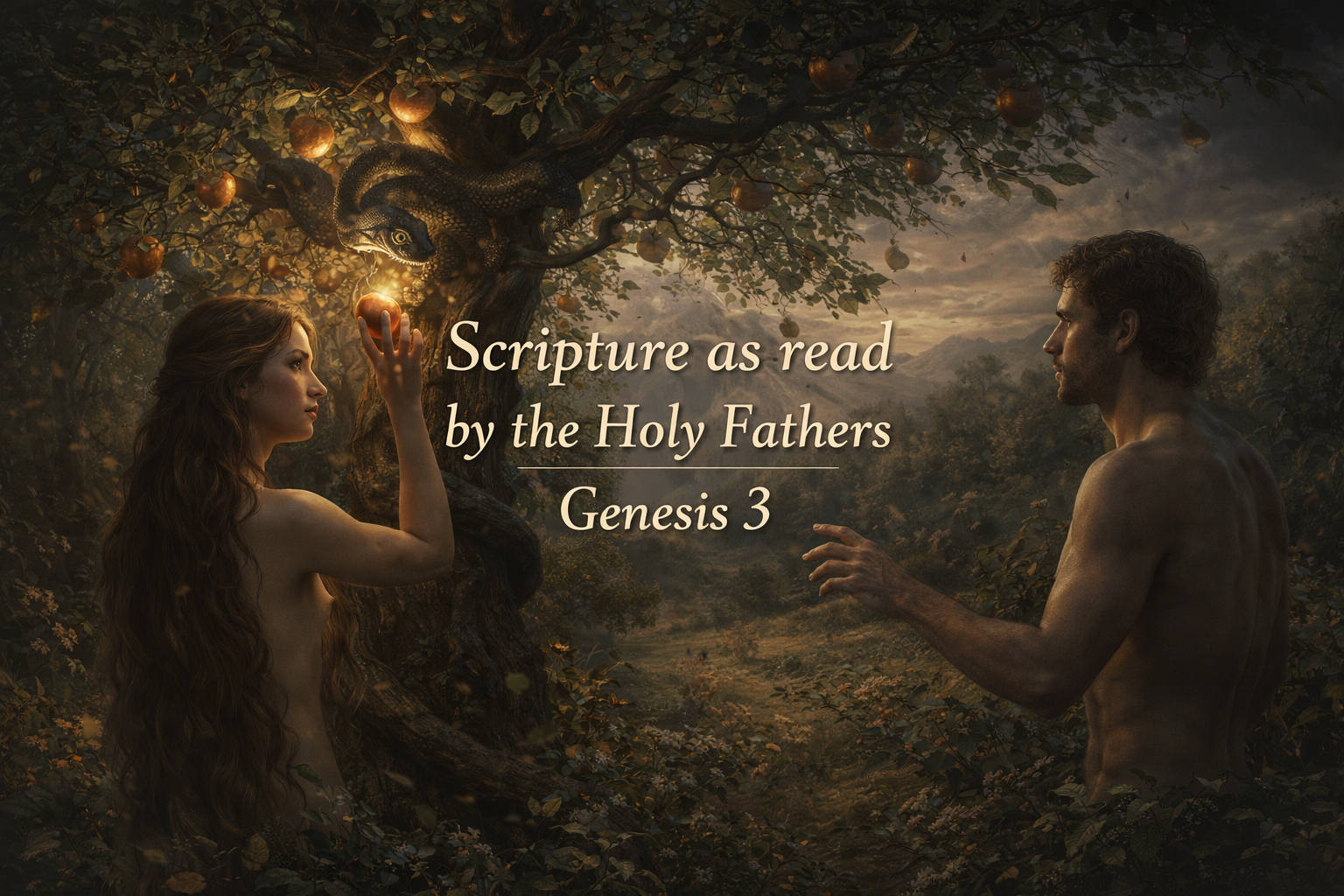
Genesis 3 — Daily Scripture Deep Dive
This chapter marks the transition from created harmony to wounded communion, and introduces the entire drama of salvation history, which will only be resolved in Christ.
Genesis 3:1–5
Section 1 — Text Reference (RSV-2CE)
Genesis 3:1–5 (by reference)
Key phrases (RSV-2CE):
- “Now the serpent was more subtle than any other wild creature” (v.1)
- “Did God say…?” (v.1)
- “You will not die” (v.4)
- “You will be like God, knowing good and evil” (v.5)
(Full text assumed open in the Ignatius RSV-2CE.)
Section 2 — Patristic Meaning (Primary Governing Layer)
The Serpent and the Strategy of Deception
The Fathers unanimously identify the serpent as Satan acting through a created instrument, not as a mere symbol.
St. Irenaeus of Lyons, Against Heresies, V.21.1:
“The devil, having become apostate, was the first to transgress the commandment of God, and persuaded man to transgress it also. Thus he brought upon him the death which he himself had incurred.”
The serpent’s subtlety lies not in force, but in distortion of truth. He does not deny God outright; he reframes God.
“Did God say…?” — The Attack on Trust
St. John Chrysostom, Homilies on Genesis, Homily 16:
“Observe the devil’s cunning: he does not immediately urge disobedience, but first casts doubt upon the commandment, weakening the woman’s confidence in God’s word.”
The first sin begins not with disobedience, but with suspicion.
“You Will Not Die” — The Denial of Consequence
St. Augustine of Hippo, City of God, XIV.11:
“The lie was this: that death would not follow disobedience. For death did follow, though not at once in the body, yet immediately in the soul.”
Death first enters interiorly, before it manifests biologically.
“You Will Be Like God” — The Perverted Desire
St. Gregory of Nyssa, On the Making of Man:
“Man was created for participation in the divine good, but the evil one promised divinity without God, knowledge without obedience, and ascent without grace.”
The temptation is not godlessness, but false divinization.
Section 3 — Daily Christian Application
The serpent still speaks today by:
- Reframing God’s commandments as restrictions
- Suggesting that obedience limits fulfillment
- Promising life, autonomy, or peace without repentance
Daily vigilance begins with guarding trust:
Do I interpret God’s commands as love — or as deprivation?
Section 4 — Theosis Dimension
Man was truly created to become “like God” — by grace.
The fall consists in attempting theosis without communion, ascent without humility, illumination without obedience.
True theosis:
- Passes through trust
- Is received, not seized
- Is granted by God, not extracted from Him
Section 5 — Interior / Spiritual Sense (Virtues & Vices Integrated)
Vice Exposed
- Pride — desire for self-grounded divinity
- Suspicion — mistrust of God’s goodness
- Disobedience of the nous — intellect turning away from divine truth
Virtue Called Forth
- Humility — remaining creature before God
- Faith — trusting God’s word over inner dialogue
- Obedience — aligning will with truth
The serpent always begins with thoughts (logismoi), not actions.
Section 6 — Mystical Christology
Christ enters history as the New Adam, to undo precisely what is introduced here.
Where Adam listened to the serpent,
Christ rejects Satan with:
“Man shall not live by bread alone” (Matt 4:4)
The lie “you will not die” is overturned by Christ dying — to destroy death.
The false promise “you will be like God” is fulfilled truly in Christ:
“He became man so that man might become god”
— St. Athanasius of Alexandria, On the Incarnation
Genesis 3:6–7
Section 1 — Text Reference (RSV-2CE)
Genesis 3:6–7 (by reference)
Key phrases (RSV-2CE):
- “she took of its fruit and ate” (v.6)
- “and she also gave some to her husband, and he ate” (v.6)
- “the eyes of both were opened” (v.7)
- “they knew that they were naked” (v.7)
- “they sewed fig leaves together” (v.7)
(Full text assumed open in the Ignatius RSV-2CE.)
Section 2 — Patristic Meaning (Primary Governing Layer)
The Act of Disobedience
The Fathers emphasize the sobriety and ordinariness of the fall. There is no frenzy, no coercion — only consent.
St. Irenaeus of Lyons, Against Heresies, V.23.1:
“Eve, by disobeying, became the cause of death for herself and for the whole human race; so also Mary, being obedient, became the cause of salvation for herself and for the whole human race.”
The fall is not primarily bodily, but volitional.
Adam’s Silence and Failure of Headship
The Fathers note that Adam was present, not deceived in the same way as Eve, and yet remained silent.
St. John Chrysostom, Homilies on Genesis, Homily 16:
“Adam was not deceived, but sinned willingly. He failed to restrain the woman and failed to recall the commandment entrusted to him.”
This is not domination but abdicated spiritual responsibility.
“The Eyes of Both Were Opened” — Knowledge Through Loss
This “opening” is not enlightenment but alienation.
St. Augustine of Hippo, City of God, XIV.17:
“They were not blind before, but they were naked and not ashamed. Their eyes were opened, not to see what they had not seen, but to feel what they had not felt.”
Knowledge arrives through wound, not fulfillment.
Nakedness and Shame
Shame is not intrinsic to the body, but arises when the soul loses its interior garment of grace.
St. Gregory of Nyssa, On the Making of Man:
“When the divine likeness was obscured, man perceived his condition as naked, stripped of the beauty that once clothed him.”
The body reveals what the soul has lost.
The Fig Leaves — False Covering
The fig leaves symbolize human attempts to heal spiritual loss by external means.
St. Ephrem the Syrian, Hymns on Paradise:
“They covered their bodies with leaves, but the wound was within. They hid from one another, but not from God.”
Section 3 — Daily Christian Application
Sin today still unfolds the same way:
- Interior consent
- External act
- Immediate self-awareness
- Attempted self-justification or concealment
We often respond to shame by:
- External fixes
- Image management
- Self-made coverings
But grace heals from within outward, never the reverse.
Section 4 — Theosis Dimension
Before the fall, the body was transparent to grace.
After the fall:
- The soul no longer illumines the body
- The body becomes opaque
- Shame emerges as a sign of disrupted communion
Theosis restores:
- Interior light
- Harmony between soul and body
- Fearless presence before God
Section 5 — Interior / Spiritual Sense (Virtues & Vices Integrated)
Vices Manifested
- Disobedience — consent against known command
- Passivity — failure to guard the heart
- Shame — awareness without healing
Virtues Called Forth
- Watchfulness (nepsis) — guarding consent
- Courage — standing exposed before God
- Truthfulness — refusing false coverings
Shame becomes salvific only when it leads to repentance, not concealment.
Section 6 — Mystical Christology
Adam eats and hides.
Christ eats and reveals:
- Adam eats the fruit and is exposed
- Christ offers His Body and clothes us
The fig leaves anticipate baptismal garments.
St. Cyril of Jerusalem, Catechetical Lectures:
“Having stripped ourselves in baptism of the old garment of sin, we are clothed with Christ.”
Where Adam covers himself,
Christ covers us with Himself.
Genesis 3:8–13
Section 1 — Text Reference (RSV-2CE)
Genesis 3:8–13 (by reference)
Key phrases (RSV-2CE):
- “they heard the sound of the LORD God walking in the garden in the cool of the day” (v.8)
- “the man and his wife hid themselves” (v.8)
- “Where are you?” (v.9)
- “I was afraid, because I was naked” (v.10)
- “The woman whom thou gavest to be with me…” (v.12)
- “The serpent beguiled me, and I ate” (v.13)
(Full text assumed open in the Ignatius RSV-2CE.)
Section 2 — Patristic Meaning (Primary Governing Layer)
God’s Descent — Not for Judgment, but for Healing
The Fathers unanimously affirm that God’s “walking” is condescension, not locomotion — a manifestation adapted to fallen man.
St. Gregory the Theologian, Oration 29:
“The voice of God walking is not movement in space, but the manifestation of God to one who has fallen away, that He might recall him.”
God comes seeking, not fleeing.
“Where Are You?” — The Call to Self-Knowledge
God’s question is therapeutic, not informational.
St. John Chrysostom, Homilies on Genesis, Homily 17:
“He asks not because He is ignorant, but to bring the sinner to confession.”
The first invitation after sin is speech, not punishment.
Fear Replaces Filial Confidence
“I was afraid” marks a radical rupture: fear enters where love once ruled.
St. Augustine of Hippo, City of God, XIV.14:
“Fear followed disobedience, because love had departed.”
Fear is the fruit of broken communion, not divine wrath.
The Birth of Excuse and Accusation
Adam’s response fractures communion on three levels:
- With God (“whom thou gavest”)
- With woman
- With truth
St. Ephrem the Syrian, Hymns on Paradise:
“Adam accused the woman, and by this accusation wounded himself again.”
Eve, likewise, shifts responsibility — not falsely, but incompletely.
Failure of Repentance
The Fathers note with severity: neither repents.
St. Ambrose of Milan, On Paradise:
“They confessed the deed, but not the sin.”
Confession without contrition heals nothing.
Section 3 — Daily Christian Application
After sin, God still approaches.
Yet we often respond by:
- Hiding
- Rationalizing
- Explaining instead of repenting
- Naming causes instead of confessing guilt
God’s question remains:
Where are you?
—not “What have you done?”
Section 4 — Theosis Dimension
The fall did not remove God’s desire for communion.
Theosis begins precisely here:
- God seeks
- Man must answer truthfully
Refusal of truth delays healing; humble confession restores the path to divine likeness.
Section 5 — Interior / Spiritual Sense (Virtues & Vices Integrated)
Vices Manifested
- Fear — avoidance of God’s presence
- Self-justification — defense of ego
- Accusation — fragmentation of love
Virtues Called Forth
- Truthfulness — standing exposed before God
- Compunction — sorrow without excuse
- Responsibility — owning one’s consent
The soul heals when it stops explaining and starts repenting.
Section 6 — Mystical Christology
Adam hides among the trees.
Christ will later hang upon a tree — exposed, not hiding.
Adam blames the woman.
Christ receives the Church — His Bride — without accusation.
Where Adam answers with fear,
Christ answers the Father with obedience:
“Not my will, but thine, be done” (Luke 22:42)
The divine search begun here will end on the Cross.
Genesis 3:14–15
Section 1 — Text Reference (RSV-2CE)
Genesis 3:14–15 (by reference)
Key phrases (RSV-2CE):
- “Because you have done this” (v.14)
- “upon your belly you shall go” (v.14)
- “I will put enmity between you and the woman” (v.15)
- “between your seed and her seed” (v.15)
- “he shall bruise your head, and you shall bruise his heel” (v.15)
(Full text assumed open in the Ignatius RSV-2CE.)
Section 2 — Patristic Meaning (Primary Governing Layer)
The Serpent Judged First
The Fathers emphasize that judgment begins with the deceiver. The curse is not directed to animals but to the spiritual enemy who used the animal as instrument.
St. Irenaeus of Lyons, Against Heresies, V.21.1:
“The Lord pronounced judgment upon the serpent, not as a beast merely, but as him who had deceived man, casting him down from the height of life.”
The serpent is humiliated: what sought elevation is cast down.
“Upon Your Belly You Shall Go” — The Abasement of Pride
The Fathers read this as a symbol of spiritual humiliation, not zoology.
St. Augustine of Hippo, City of God, XIV.17:
“To creep upon the belly is to be dragged by earthly desires, since pride, having been cast down, feeds on dust.”
The devil’s punishment corresponds exactly to his sin.
The Protoevangelium — First Gospel Promise
Genesis 3:15 is unanimously recognized as the Protoevangelium, the first announcement of redemption.
St. Jerome, Hebrew Questions on Genesis:
“This is the first promise of the Savior, who would come to conquer the serpent and restore mankind.”
Judgment turns immediately into promise.
“The Woman” and “Her Seed”
The Fathers read this verse Christologically and Marianly, without separation.
St. Irenaeus of Lyons, Against Heresies, V.19.1:
“The knot of Eve’s disobedience was loosed by the obedience of Mary; what the virgin Eve bound by unbelief, the Virgin Mary unbound by faith.”
The “woman” is Eve — but also Mary, the New Eve.
The Crushing of the Serpent’s Head
The victory is decisive, though achieved through suffering.
St. Gregory the Great, Moralia on Job:
“The head of the serpent is pride, which Christ crushed when He humbled Himself unto death.”
The heel is wounded; the head is destroyed.
Section 3 — Daily Christian Application
God does not abandon fallen man to explanation or guilt.
He promises victory before demanding effort.
Christian life begins not with optimism, but with hope grounded in God’s action.
The enemy still wounds — but no longer rules.
Section 4 — Theosis Dimension
Theosis is restored through conflict, not avoidance.
Man’s healing involves:
- Enmity with sin
- Separation from the serpent’s logic
- Participation in Christ’s victory
Neutrality toward evil is impossible after this promise.
Section 5 — Interior / Spiritual Sense (Virtues & Vices Integrated)
Vice Condemned
- Pride — serpent’s head
- Deception — corruption of truth
- False peace with sin
Virtues Established
- Holy enmity — hatred of sin
- Hope — confidence in divine victory
- Perseverance — enduring the wounded heel
Spiritual life requires enmity, not compromise.
Section 6 — Mystical Christology
This verse already contains:
- The Cross (the wounded heel)
- The Resurrection (the crushed head)
- The Incarnation (the Seed of the Woman)
- The Virgin Birth (seed without male origin)
St. Athanasius of Alexandria, On the Incarnation:
“The Word took flesh to overthrow the tyrant, and by His death to bring death to nothing.”
The entire Gospel is compressed here.
Genesis 3:16–19
Section 1 — Text Reference (RSV-2CE)
Genesis 3:16–19 (by reference)
Key phrases (RSV-2CE):
- “I will greatly multiply your pain in childbearing” (v.16)
- “your desire shall be for your husband, and he shall rule over you” (v.16)
- “cursed is the ground because of you” (v.17)
- “in toil you shall eat of it all the days of your life” (v.17)
- “thorns and thistles it shall bring forth” (v.18)
- “by the sweat of your face you shall eat bread” (v.19)
- “for dust you are, and to dust you shall return” (v.19)
(Full text assumed open in the Ignatius RSV-2CE.)
Section 2 — Patristic Meaning (Primary Governing Layer)
Judgment as Consequence, Not Revenge
The Fathers are unanimous: these words are not vindictive punishments, but therapeutic consequences flowing from the rupture of communion.
St. John Chrysostom, Homilies on Genesis, Homily 17:
“These things were not imposed as acts of vengeance, but as medicines. For God corrected man so that he might not remain forever in sin.”
The judgment restrains evil and reorients man toward humility.
The Woman — Suffering in the Sphere of Love
Pain enters precisely where life is given.
St. Augustine of Hippo, Literal Commentary on Genesis, XI.36:
“The pain of childbirth was added not to destroy generation, but to humble pride, lest man forget his dependence on God.”
The disorder of desire (“he shall rule over you”) is read as a distortion, not a divine ideal.
The Man — Toil in the Sphere of Dominion
The curse does not fall on Adam directly, but on the ground entrusted to him.
St. Ambrose of Milan, On Paradise:
“The earth was cursed because man had turned away from heaven.”
Labor becomes heavy because interior harmony has been lost.
Thorns and Thistles — Creation Reflects the Fall
Creation now mirrors man’s interior state.
St. Gregory of Nyssa, On the Making of Man:
“When the soul was no longer governed by reason, nature herself resisted man’s dominion.”
Disorder propagates outward.
“Dust You Are” — Mortality Revealed
Death is not newly created here; it is declared.
St. Irenaeus of Lyons, Against Heresies, V.23.2:
“Man was mortal by nature, but immortal by grace; losing grace, he returned to what he was.”
Death is the withdrawal of sustaining communion.
Section 3 — Daily Christian Application
We encounter these judgments daily:
- Strained relationships
- Exhausting labor
- Resistance from the world
- Bodily frailty
These are not signs of abandonment, but calls to humility and repentance.
Grace transforms burden into offering.
Section 4 — Theosis Dimension
Theosis now unfolds through suffering, not innocence.
Pain, toil, and mortality become:
- Places of purification
- Sites of obedience
- Paths toward union
Suffering accepted in faith becomes participation, not punishment.
Section 5 — Interior / Spiritual Sense (Virtues & Vices Integrated)
Vices Revealed
- Domination — distortion of love
- Resistance — creation mirroring inner rebellion
- Despair — misreading suffering as meaningless
Virtues Cultivated
- Humility — accepting limits
- Perseverance — laboring faithfully
- Hope — seeing beyond dust
The fallen world becomes an ascetical school.
Section 6 — Mystical Christology
Christ enters every dimension of this judgment:
- Born of woman — embracing childbirth pain
- Crowned with thorns — bearing the curse of the ground
- Sweats blood — fulfilling “by the sweat of your face”
- Laid in the dust — “to dust you shall return”
St. Athanasius of Alexandria, On the Incarnation:
“He took a body capable of death, that He might destroy death from within.”
The curse is assumed to be healed.
Genesis 3:20–24
Section 1 — Text Reference (RSV-2CE)
Genesis 3:20–24 (by reference)
Key phrases (RSV-2CE):
- “The man called his wife’s name Eve” (v.20)
- “because she was the mother of all living” (v.20)
- “the LORD God made for Adam and for his wife garments of skins” (v.21)
- “lest he put forth his hand and take also of the tree of life” (v.22)
- “he drove out the man” (v.24)
- “the cherubim, and a flaming sword which turned every way” (v.24)
(Full text assumed open in the Ignatius RSV-2CE.)
Section 2 — Patristic Meaning (Primary Governing Layer)
The Naming of Eve — Hope After the Fall
Remarkably, Adam names the woman after the judgment, not before. The Fathers see this as an act of faith in the promise just given.
St. Irenaeus of Lyons, Against Heresies, III.23.7:
“After hearing that the seed of the woman would bruise the serpent’s head, Adam called his wife the mother of all living, showing faith in the life yet to come.”
Hope is born within exile, not before it.
The Garments of Skins — Divine Mercy, Not Mere Covering
The Fathers unanimously reject the idea that these garments are merely practical clothing. They signify God’s merciful accommodation to fallen humanity.
St. John Chrysostom, Homilies on Genesis, Homily 18:
“God Himself clothed them, teaching that though they had sinned, they were not abandoned.”
St. Gregory of Nyssa, On the Making of Man:
“The garments of skin signify mortality, which God permitted as a remedy, lest sin become immortal.”
Death itself becomes medicinal, not final.
Exile from Eden — Protection, Not Cruelty
God bars access to the Tree of Life out of mercy.
St. Augustine of Hippo, City of God, XIII.20:
“Man was driven from the tree of life lest he live forever in misery.”
Immortality without healing would be eternal corruption.
The Cherubim and the Flaming Sword
The Fathers read this image liturgically and mystically.
St. Ephrem the Syrian, Hymns on Paradise:
“The sword turns every way because access to Paradise is closed until the blood of the Son opens it.”
The way is closed — temporarily.
Section 3 — Daily Christian Application
God’s mercy after sin appears as:
- Clothing, not exposure
- Distance, not annihilation
- Discipline, not rejection
Exile itself becomes a school of hope.
We must learn to recognize mercy even when it feels like loss.
Section 4 — Theosis Dimension
Man is prevented from false immortality so that he may later receive true immortality.
Theosis now requires:
- Time
- Healing
- Incarnation
- Sacrifice
Eden is not destroyed — it is guarded.
Section 5 — Interior / Spiritual Sense (Virtues & Vices Integrated)
Vices Healed
- Presumption — grasping immortality
- Despair — thinking exile is abandonment
Virtues Cultivated
- Hope — naming life amid death
- Patience — waiting for restoration
- Trust — accepting God’s timing
The flaming sword teaches reverence, not terror.
Section 6 — Mystical Christology
Everything here points to Christ:
- Eve → Mary, Mother of the Living
- Garments of skin → Christ clothing us with His flesh
- Exile → the long road to Bethlehem
- Cherubim → opened again at the Cross
- Tree of Life denied → Tree of the Cross granted
St. Athanasius of Alexandria, On the Incarnation:
“He became man that man might become god.”
Paradise is closed by Adam — and reopened by Christ.
Genesis 3 — Chapter Completed
This chapter has revealed:
- The anatomy of sin
- The patience of God
- The first promise of redemption
- Mercy hidden within judgment
- Hope planted in exile
Eden is lost — but not forgotten.
 Blog do Fernando Rees